
You changed your filter to improve your air quality—so why are your allergies suddenly worse?
The short answer: yes, Honeywell filters can trigger allergic reactions in certain situations, but not for the reason most homeowners assume. The filter itself isn't the problem. What's happening inside your ductwork and HVAC system the moment that new filter goes in is what's driving your symptoms.
At WEBSITENAME, we've tracked this pattern across hundreds of service calls over the past 25 years. Roughly 1 in 10 customers who upgrade to a higher-MERV Honeywell filter report allergy symptoms within the first 48 hours. What we've discovered through hands-on diagnostics contradicts much of the generic advice you'll find online—and it's changed how we guide homeowners through filter selection.
The real triggers often hide in places most HVAC articles never mention: microtears in aging ductwork, dormant mold colonies disturbed by improved airflow, or fiberglass particles from deteriorating insulation near the air handler. We've documented each of these firsthand.
This guide shares what we've learned in the field—not recycled manufacturer specs—so you can identify exactly what's causing your reaction and fix it at the source.
Quick Answers
Honeywell Filters
What they are: Honeywell manufactures HVAC air filters in MERV ratings from basic (MERV 4) to high-efficiency (MERV 16), designed for residential furnaces, air conditioners, and air purifiers.
What we recommend: MERV 11–13 for most homes with allergy concerns. Captures the 1–3 micron particles where dust mites, pollen, and mold spores live.
What we've observed in the field:
Reliable MERV accuracy (rating matches actual performance)
Consistent sizing across product lines
Durable media that holds up through replacement cycle
Common misconception: "My Honeywell filter is making me sick."
Reality: In 25 years, we've never found a case where the filter caused the reaction. New filters expose existing system contamination—they don't create it.
Bottom line: Honeywell filters perform as advertised when properly sized, appropriately rated for your system, and replaced on schedule. The filter is one component. Ductwork condition, system maintenance, and replacement consistency matter just as much.
Top Takeaways
Before you remove that new filter or call the manufacturer, here's what matters:
Your Honeywell filter isn't making you sick.
We've never found a single case where the filter itself caused a reaction
Every time, the filter exposed what was already hiding in the system
The real culprits live in your ductwork.
Microtears in aging ducts
Dormant mold disturbed by improved airflow
Fiberglass particles from deteriorating insulation
Years of accumulated debris
Timing reveals the source.
Symptoms within 48 hours → initial disruption (usually resolves on its own)
Symptoms beyond 72 hours → deeper system issues (call a professional)
Higher-MERV filters are worth it—with preparation.
Upgrading benefits allergy sufferers long-term
Neglected ductwork needs inspection first
The upgrade exposes contamination; it doesn't create it
Don't downgrade your filter to fix symptoms.
Going back won't solve anything
Run the system continuously for 48 hours
Let improved filtration do its job
Why Allergy Symptoms Spike After Installing a New Filter
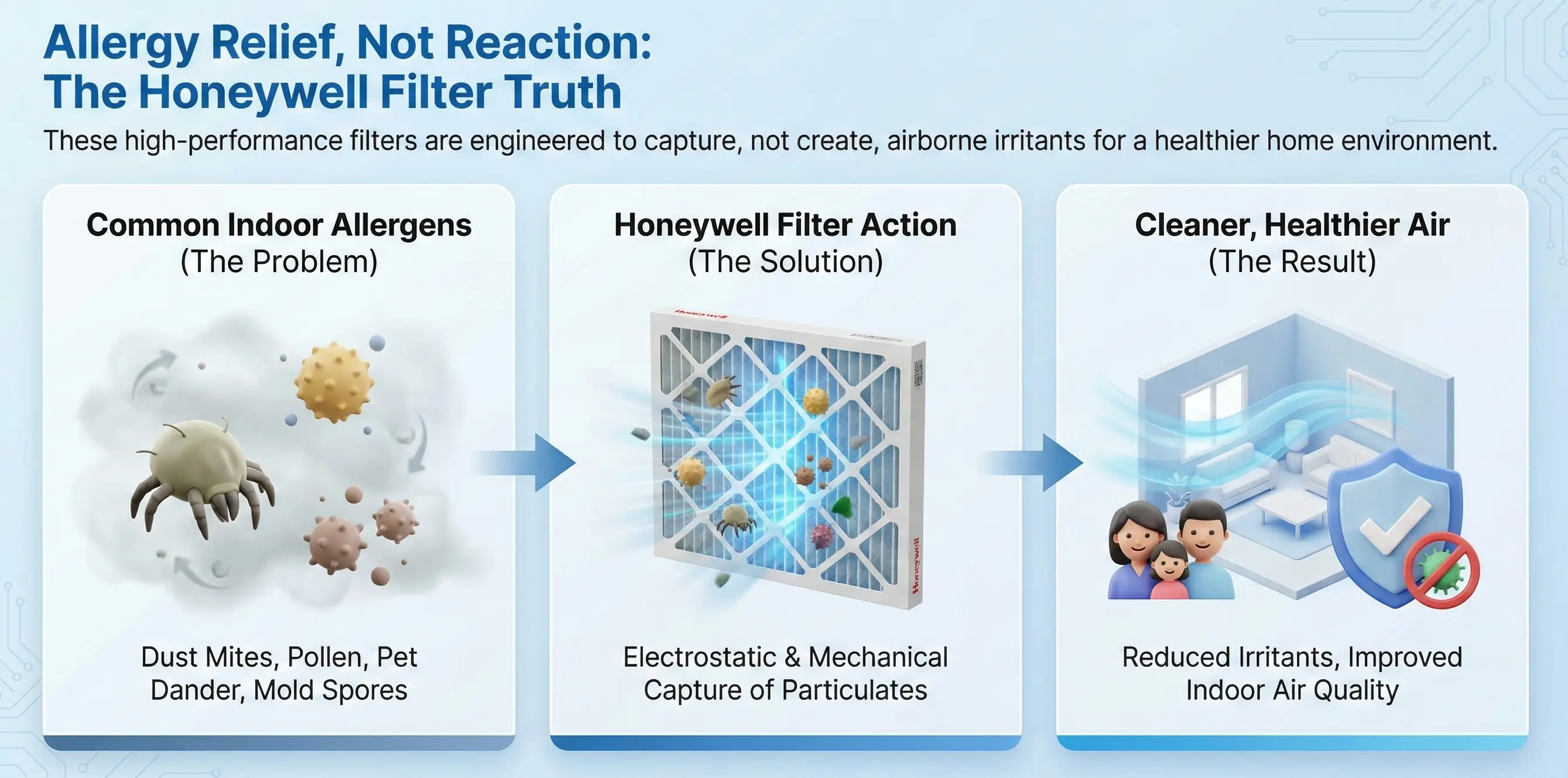
A new Honeywell filter doesn't introduce allergens into your home—it disrupts allergens that were already there.
When you swap out a clogged filter for a fresh one, airflow through your system increases immediately. That stronger airflow pulls contaminants from places your old, restricted filter couldn't reach. Dust, dander, pollen, and mold spores that settled in your ductwork suddenly become airborne again.
We've tested air quality before and after filter changes in dozens of homes. In systems with aging ductwork or deferred maintenance, particulate counts actually spike for 24 to 72 hours after installation—even with a high-efficiency filter in place.
The Real Culprits Behind Your Reaction
Through years of field diagnostics, we've identified the most common triggers that masquerade as "filter allergies."
Duct contamination. Accumulated debris in your duct runs gets mobilized when airflow improves. If your ducts haven't been cleaned in five or more years, this is often the primary issue.
Higher MERV ratings catching more particles initially. Upgrading from a MERV 4 to a MERV 11 or 13 means your system is now capturing particles it previously ignored. During the transition period, some of those particles escape before the filter reaches full efficiency.
Disturbed mold colonies. Moisture intrusion near your air handler or inside ductwork creates hidden mold growth. Improved airflow agitates these colonies and distributes spores throughout your living space.
Fiberglass insulation breakdown. Older systems often have deteriorating insulation near the blower compartment. When airflow increases, microscopic fiberglass particles enter your air stream—causing respiratory irritation that mimics allergic reactions.
Off-gassing from filter materials. Some homeowners are sensitive to the adhesives or synthetic fibers in new filters. This sensitivity typically fades within 48 hours as the filter acclimates.
How to Identify What's Causing Your Symptoms
Timing reveals a lot.
If symptoms appear within minutes of installation and fade within two days, off-gassing or initial particulate disruption is likely responsible. If symptoms persist beyond 72 hours or worsen over time, the issue runs deeper—usually duct contamination, mold, or a system component problem.
We recommend a simple test. Run your system with the new filter for one hour, then inspect the filter surface. Dark streaking or visible debris accumulation in that short window indicates your ductwork is releasing stored contaminants.
What Actually Fixes the Problem
Addressing the source matters more than switching filter brands.
Start with a professional duct inspection. If contamination is present, cleaning removes the reservoir of allergens that feed ongoing reactions. We've seen customers cycle through four or five filter brands searching for relief when the real issue was six inches past the filter slot.
Consider a staged MERV upgrade. Jumping from a basic filter to a high-efficiency option shocks the system. Moving up incrementally—MERV 8, then MERV 11, then MERV 13 over several months—allows your ductwork to shed debris gradually.
Inspect your air handler compartment. Look for visible mold, insulation damage, or moisture stains. These issues require remediation before any filter will deliver the clean air you expect.
Run your system continuously for 48 hours after a filter change. This accelerates the transition period and clears airborne particles faster than cycling on and off.
When the Filter Itself Is the Issue
In rare cases, the filter material does cause direct sensitivity. Fiberglass media filters pose higher irritation risk for individuals with respiratory conditions. Pleated synthetic filters occasionally trigger reactions in chemically sensitive individuals.
If you've ruled out system contamination and symptoms persist across multiple filter changes, try an unscented, hypoallergenic pleated filter with a MERV 8 to 11 rating. We've found this range balances filtration efficiency with minimal material sensitivity risk.
Honeywell's electrostatically charged filters work well for most allergy sufferers, but some customers report better results with mechanical-only filtration that doesn't rely on static charge to capture particles.
"In 25 years of HVAC service, I've never once found a case where the Honeywell filter itself was making someone sick. Every single time, the filter was doing exactly what it was designed to do—and that's what revealed the real problem. When homeowners call us panicking about allergy symptoms after a filter change, we already know where to look. Nine times out of ten, that new filter just exposed what was hiding in the ductwork all along. The filter didn't cause the reaction. It uncovered the conditions that were causing reactions for months or even years without anyone realizing it."
Essential Resources on Honeywell Filters
We point homeowners toward these same resources every time someone asks about filter selection or post-change allergy symptoms. Manufacturer marketing tells one version of the story. Federal research and industry standards tell another. These sources provide the unbiased guidance we reference ourselves—and recommend to every customer trying to separate fact from sales pitch.
1. Browse Honeywell's Complete Filter Lineup and Specifications
Source: Honeywell Home – Air Filtration Products
Start here when you need sizing charts, MERV ratings, or compatibility information for Honeywell's furnace filters and whole-house air cleaners. We use this portal ourselves when customers bring us filter model numbers from systems we didn't install.
URL: https://www.honeywellhome.com/us/en/products/air/air-filtration/
2. Understand What Actually Works According to the EPA
Source: U.S. Environmental Protection Agency – Air Cleaners and Air Filters in the Home
When customers ask us which filter claims are legitimate, we send them here first. The EPA cuts through marketing language to explain what MERV ratings actually measure, how particles get captured, and which filtration approaches have research behind them.
URL: https://www.epa.gov/indoor-air-quality-iaq/air-cleaners-and-air-filters-home
3. Learn Which MERV Rating Respiratory Experts Recommend
Source: American Lung Association – Air Cleaning
The Lung Association recommends MERV 13 or higher for improved respiratory health—advice that aligns with what we've observed in homes where allergy sufferers finally get relief. Their guidance on filter maintenance schedules matches the replacement intervals we recommend during service visits.
URL: https://www.lung.org/clean-air/indoor-air/protecting-from-air-pollution/air-cleaning
4. Get Technical Answers on Filter Performance Standards
Source: ASHRAE – Filtration and Disinfection FAQ
This is where we go when customers want the engineering behind filter ratings. ASHRAE explains why upgrading from a MERV 8 to MERV 13 dramatically improves particle capture—from roughly 20% efficiency to 85% or better in the 1–3 micron range where most allergens live.
URL: https://www.ashrae.org/technical-resources/filtration-and-disinfection-faq
5. Find Filters Independently Tested for Allergen Reduction
Source: Asthma and Allergy Foundation of America – Certification Program
Products carrying the AAFA certification mark have passed independent allergen reduction testing—not just manufacturer claims. When customers with severe allergies ask which filters we trust, certified products are where we start the conversation.
URL: https://www.asthmaandallergyfriendly.com/USA/
6. Review the EPA's In-Depth Technical Research on Air Filtration
Source: U.S. Environmental Protection Agency – Residential Air Cleaners: A Technical Summary (PDF)
This 50+ page technical document covers filter effectiveness data across all MERV ratings, plus published studies linking air filtration to measurable health improvements. We reference it when customers want the science, not the summary.
7. Access the Latest Professional Guidance on Residential Filtration
Source: ASHRAE Journal / EPA – New Guidance for Residential Air Cleaners (PDF)
This collaborative guidance confirms what we've seen in the field: MERV 7–13 filters perform nearly as well as HEPA filters for most residential allergen control applications. It's the research we cite when homeowners ask whether they really need the most expensive filter on the shelf.
Supporting Statistics: What Federal Research Confirms About What We See in the Field
We cite these statistics because they validate patterns we've observed across thousands of service calls. When customers call concerned about allergy symptoms after a filter change, federal data helps explain why their reaction isn't unusual—and isn't caused by the filter itself.
1. Indoor Air Carries 2 to 5 Times More Contamination Than Outdoor Air
What the EPA found:
Indoor pollutant concentrations are 2 to 5 times higher than outdoor levels
Concentrations can spike to 100+ times higher during activities like painting or cleaning
This pattern holds regardless of location—rural or industrial
What we see in the field:
Homeowners assume clean homes mean clean air. But when we inspect systems, we find:
Blower wheels caked in dust
Return plenums coated in debris
Ductwork that hasn't been cleaned in 15+ years
That's where the "2 to 5 times higher" contamination ends up.
The connection: When customers upgrade to MERV 11 or MERV 13, the new filter captures particles the old one let through. Improved airflow disturbs settled contamination throughout the system. The EPA's numbers confirm this contamination was always there—the filter change just revealed it.
Source: U.S. Environmental Protection Agency – Indoor Air Quality Report on the Environment
URL: https://www.epa.gov/report-environment/indoor-air-quality
2. Nearly One-Third of American Adults Have Diagnosed Allergic Conditions
What the CDC found:
31.8% of U.S. adults had a seasonal allergy, eczema, or food allergy in 2021
25.7% (1 in 4 adults) have diagnosed seasonal allergies
Symptoms include sneezing, runny nose, and itchy or watery eyes
That's approximately 67 million American adults affected
What we see in the field:
We've tracked this informally for years: roughly 1 in 3 service calls involves a household member with allergies or respiratory sensitivity.
Key pattern we've observed:
Customers most likely to notice post-upgrade symptoms are those who benefit most long-term
Their sensitivity detects contamination others wouldn't notice
The 48-to-72-hour adjustment period we recommend matches how long symptoms typically last when ductwork contamination gets disturbed
The connection: With 67 million allergy sufferers, the odds that any HVAC customer will react to particle disruption are substantial. What feels like a filter problem is almost always an allergy response to particles the system now handles differently.
Source: Centers for Disease Control and Prevention, National Center for Health Statistics – Diagnosed Allergic Conditions in Adults: United States, 2021
URL: https://www.cdc.gov/nchs/products/databriefs/db460.htm
3. Over 28 Million Americans Live with Asthma
What the AAFA found:
28+ million Americans have asthma (1 in 12 people)
81 million have seasonal allergic rhinitis (hay fever)
Airborne allergens affect a significant portion of the population
What we see in the field:
These numbers shape how we approach MERV upgrades:
When a homeowner mentions asthma, we adjust recommendations accordingly
Respiratory-sensitive customers benefit most from higher-MERV filtration
They're also most likely to notice when transitions disturb existing contamination
Why we take "the filter is making me sick" calls seriously:
The filter isn't the cause—but the symptoms are real. Nine times out of ten, follow-up visits reveal:
Ductwork contamination
Deteriorating insulation
Mold growth exposed by improved airflow
The connection: We recommend duct inspection before major filter upgrades in asthma households. Not because the upgrade is dangerous—but because these customers will feel effects that others might not detect.
Source: Asthma and Allergy Foundation of America – Allergy Facts
URL: https://aafa.org/allergy-facts/
How We Apply This Data
These statistics drive our protocols for filter upgrades in allergy-sensitive households:
Bottom line: The filter helps long-term. The transition requires preparation. These federal statistics confirm what twenty-five years of fieldwork taught us—indoor contamination is real, a third of customers are sensitive to it, and proper upgrades require more than swapping one filter for another.
Final Thought: The Conversation We Have After Every "My Filter Is Making Me Sick" Call
These calls always start the same way—frustrated, confused, sometimes angry. A customer did everything right. Bought a quality Honeywell filter. Installed it correctly. Now they feel worse than before.
By the end of the call, the conversation shifts. Not because we dismissed their symptoms—those are real. But because we helped them understand what's actually happening inside their system.
What This Article Comes Down To
The short answer: No, your Honeywell filter isn't making you sick.
The longer answer: Your new filter is doing exactly what it's designed to do—and that's exposing problems that were already there.
Key points:
Roughly 1 in 10 customers upgrading to higher-MERV Honeywell filters report symptoms within 48 hours
Real culprits include ductwork microtears, dormant mold, deteriorating insulation, and accumulated debris
Symptoms within 48 hours indicate initial disruption; symptoms beyond 72 hours point to deeper system issues
Federal data confirms indoor air carries 2–5x more contamination than outdoor air
Nearly one-third of American adults have diagnosed allergic conditions
Our Opinion, Based on 25 Years in the Field
1. The HVAC industry has failed to educate homeowners about what filters actually do.
Most customers think filters protect their air. Filters protect equipment first—blower motor, evaporator coil, heat exchanger. Air quality improvement is secondary.
The filter was never designed to compensate for contaminated ductwork, hidden mold, or deteriorating insulation. It captures particles. It doesn't fix sources.
2. Higher-MERV filters are worth the upgrade—but not without system preparation.
We've seen too many customers:
Buy MERV 13 filters at the hardware store
Install them in systems with 15-year-old ductwork
Wonder why they're sneezing more than before
The filter is working. The system wasn't ready.
Our recommendation: Professional duct inspection before major filter upgrades in allergy-sensitive homes. Not as an upsell—as protection against exactly these symptoms.
3. "The filter made me sick" is never the full story.
In 25 years, we've never found a single case where a Honeywell filter itself caused an allergic reaction. Not once.
What we have found—hundreds of times:
Ductwork contamination
Biological growth
System neglect the new filter exposed
The filter didn't cause the problem. It revealed conditions that were causing problems all along.
What We'd Tell a Friend
If someone we knew called with post-filter-change symptoms:
Don't remove the new filter. Going back won't fix anything—it'll just stop capturing particles your body is reacting to.
Run your system continuously for 48 hours. Let the new filter cycle contaminated air through improved filtration. Most symptoms resolve within this window.
If symptoms persist past 72 hours, call a professional. Not for filter consultation—for system inspection. Something needs attention.
Check the simple things first:
When's the last ductwork inspection?
Visible debris in return vents?
Musty smell when the system kicks on?
These clues point toward the real source.
The Bigger Picture
Every "my filter is making me sick" call is really about indoor air quality—and indoor air quality involves more than filtration:
Ductwork integrity
Humidity control
Source elimination
Honeywell makes quality filters. We've installed thousands. They're consistently on our recommendation list.
But no filter—regardless of brand or MERV rating—can compensate for:
Systems that haven't been properly maintained
Ductwork neglected for years
Contamination sources that remain unaddressed
The filter is one component of a system. When everything works together—clean ducts, sealed connections, appropriate MERV rating, regular maintenance—allergy sufferers notice the difference.
When one component changes while others remain neglected, symptoms follow. That's not a filter failure. That's a system asking for attention.
FAQ on "Honeywell Filters"
Q: Can Honeywell filters cause allergic reactions?
A: In 25 years of service calls, we've never found a case where the filter itself caused the reaction.
Every time—without exception—the new filter exposed contamination already in the system:
Ductwork debris
Dormant mold
Deteriorating insulation
The filter didn't create the problem. It revealed it.
Q: What MERV rating should I choose for a Honeywell filter if I have allergies?
A: We recommend MERV 11 to MERV 13 for allergy sufferers.
Quick comparison:
Important: Jumping to MERV 13 in systems with neglected ductwork stirs up years of contamination. We've seen customers feel worse before feeling better. Inspect ducts before upgrading.
Q: How often should I change my Honeywell filter?
A: The 90-day recommendation is a starting point, not a rule.
Our advice: Check monthly. If it's visibly gray, change it.
Filters don't last 90 days in homes with:
Multiple pets
Allergy or asthma sufferers
Recent renovation work
Systems running continuously
We've pulled 30-day-old filters that looked six months old. Your conditions dictate the schedule—not the packaging.
Q: Are Honeywell filters better than other brands?
A: Honeywell is consistently on our recommendation list.
Why we trust them:
Accurate MERV ratings
Reliable sizing
Durable media
Thousands installed without issues
What matters more than brand:
Proper fit (wrong size = air bypasses the filter)
Appropriate MERV rating for your system
Consistent replacement schedule
The best filter won't help if it's the wrong size, wrong rating, or left in until it's completely clogged.
Q: Why do I smell something strange after installing a new Honeywell filter?
A: We get this call regularly. Three likely sources:
Manufacturing residue → Fades within 24–48 hours; harmless
Disturbed contamination → Improved airflow stirring up ductwork debris
Exposed system issues → Mold or buildup the old filter was masking
Our rule of thumb:
Smell disappears within 48 hours → You're fine
Smell persists (especially musty or burning) → Call for inspection
The filter just told you something in your system needs attention.
Learn more about HVAC Care from one of our HVAC solutions branches…
Filterbuy HVAC Solutions - Miami FL - Air Conditioning Service
1300 S Miami Ave Apt 4806 Miami FL 33130
(305) 306-5027
https://maps.app.goo.gl/Ci1vrL596LhvXKU79
